
Airtel Money has more than doubled its customer base since 2021 and now processes nearly $200 billion in transactions a year. The proposed Airtel Money IPO in London will put a public price on that growth. The terms under discussion suggest investors are already applying some discipline.
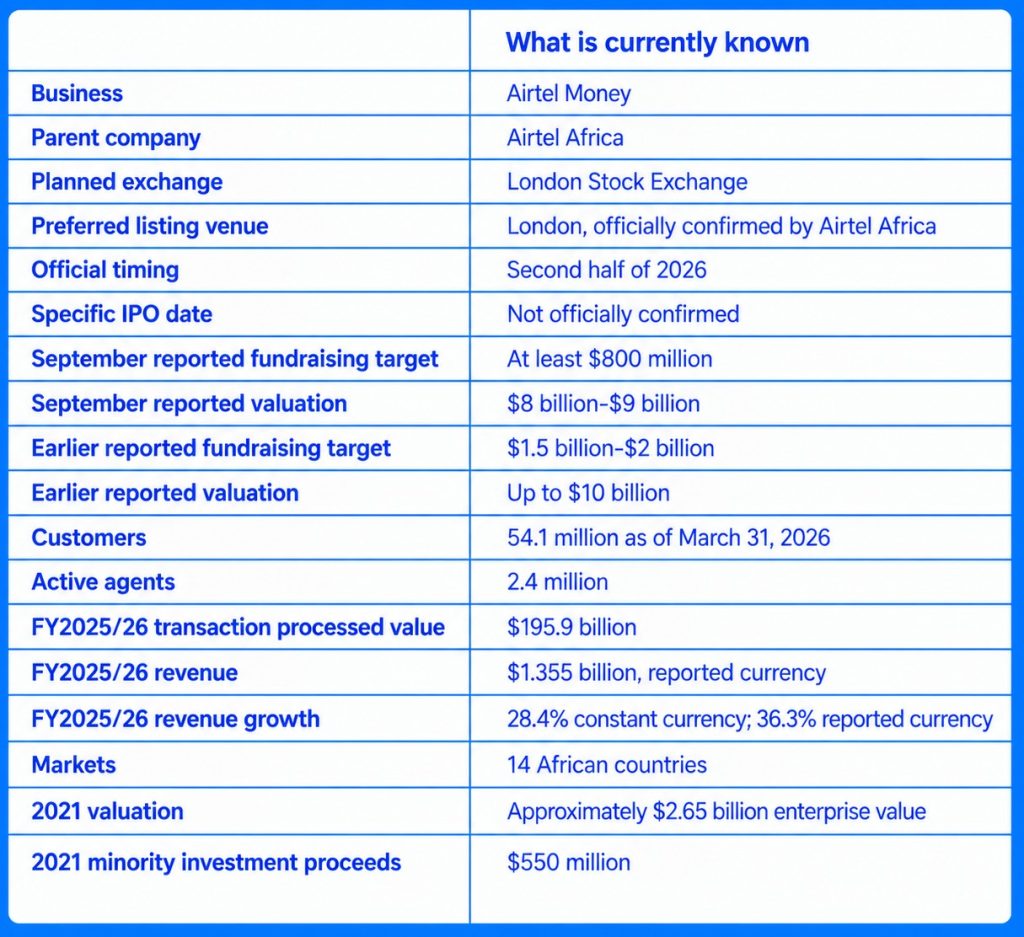
In April, Airtel Money was reportedly considering raising between $1.5 billion and $2 billion at a valuation of up to $10 billion. By September, Bloomberg reported that the company was seeking at least $800 million, with a valuation of between $8 billion and $9 billion under consideration following investor feedback.
Airtel Africa has confirmed London as its preferred listing venue and expects the IPO to take place in the second half of 2026. The final size and valuation have yet to be announced. For African fintech, the eventual pricing will provide a rare public-market reference for a financial technology business operating at continental scale.
Airtel Money is already a large financial business
Airtel Money ended its 2025/26 financial year with 54.1 million customers, up 21.3% year on year, and 2.4 million active agents. The business processed $195.9 billion in transactions during the year and generated $1.355 billion in revenue, an increase of 28.4% in constant currency. It also reported underlying EBITDA of $689 million, giving it an EBITDA margin of 50.8%.
Its services now extend beyond transfers and cash withdrawals to merchant payments, savings, lending, insurance and international money transfers across Airtel Africa’s 14 markets. Those numbers are considerably larger than when external investors first put a price on the business.
In 2021, TPG’s Rise Fund, Mastercard, Qatar Holding and Chimera Investment agreed to an investment worth a combined $550 million in Airtel Money. The transactions valued the business at $2.65 billion on a cash-and-debt-free basis. At the end of March 2021, Airtel Money had 21.7 million customers. Five years later, that figure has reached 54.1 million.
The valuation has increased too, although not at the same pace as some of the company’s operating metrics. At the reported $8 billion to $9 billion IPO valuation, Airtel Money would be valued at roughly 5.9 to 6.6 times its FY2026 revenue and around 11.6 to 13.1 times underlying EBITDA.
The $10 billion valuation reported earlier this year would have represented about 7.4 times FY2026 revenue. The eventual IPO price will therefore provide a useful indication of how much value public investors attach to Airtel Money’s growth since its 2021 private investment round.
How does Airtel Money compare with African fintech valuations?
An $8 billion to $9 billion valuation would put Airtel Money well above the most recently disclosed private valuations of many of Africa’s best-known fintech companies.
Flutterwave’s latest disclosed valuation is $3.2 billion, following its Series E in June 2026. OPay’s valuation was approximately $2.75 billion based on the value Opera assigned to its 9.4% stake in 2024, making this an implied valuation rather than the result of a new funding round. Moniepoint crossed the $1 billion valuation mark when it announced the first close of its Series C in October 2024, and completed the round in October 2025 with more than $200 million raised in total.
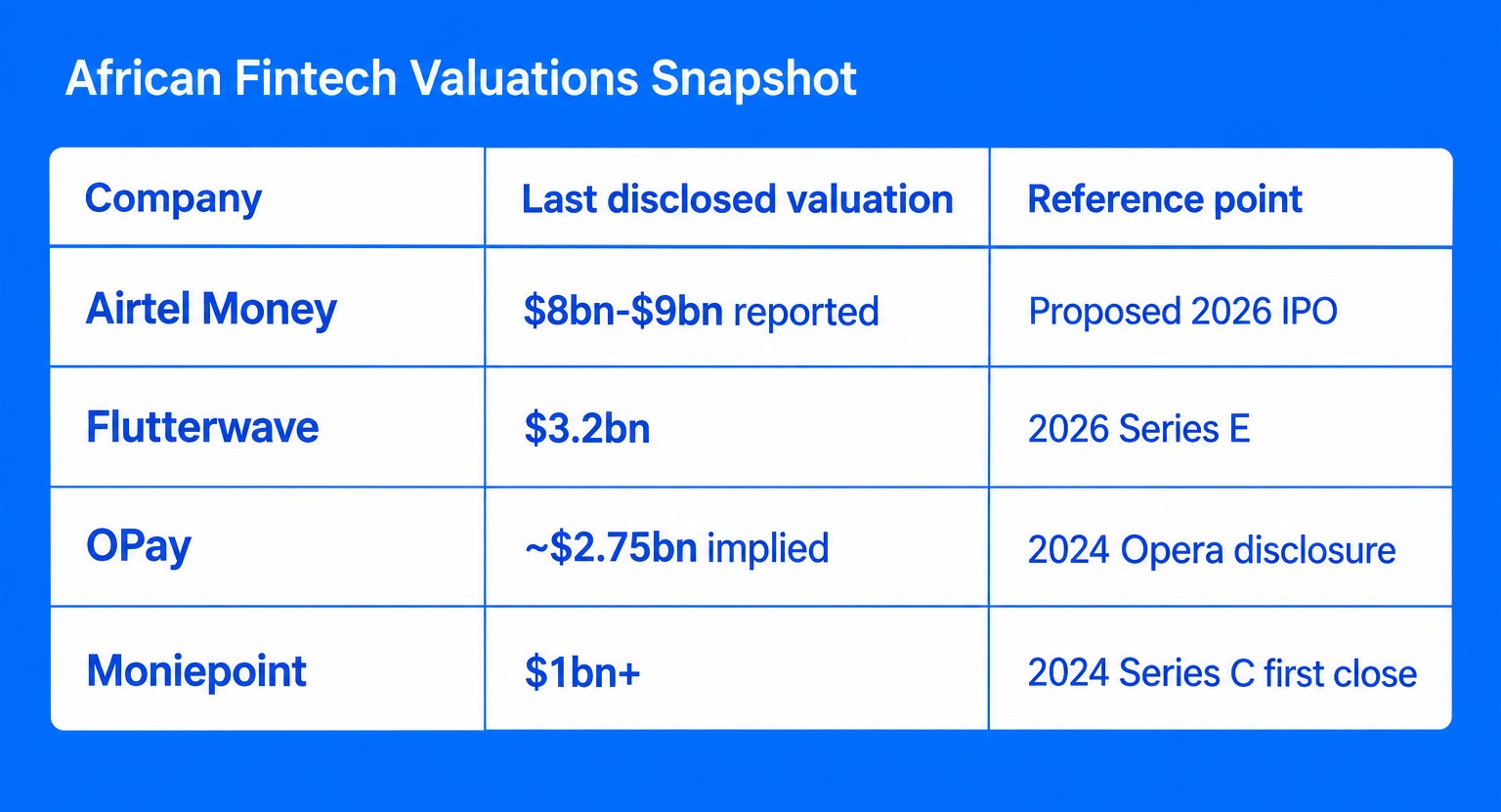
These businesses are not identical. Flutterwave, OPay, Wave and Moniepoint are private fintechs, while Airtel Money is a mobile-money platform inside a telecommunications group. But the comparison shows where the reported IPO valuation sits relative to the last disclosed private valuations in the sector.
Airtel Money’s biggest advantage is the fact that it is leveraging its large telecommunications distribution network behind the financial-services business. Once listed, Airtel Money’s valuation will be tested continuously against its revenue, earnings, growth and outlook.
What the valuation change tells us
The reduction in the reported valuation appears to have been driven partly by investor feedback as Airtel Money moved closer to the public markets. Bloomberg’s September reporting said the company was considering a valuation of $8 billion to $9 billion, down from the previously reported $10 billion, while also reducing the amount it was seeking to raise.
That does not necessarily mean the business itself has become less valuable. The IPO process is different from a private funding round because the company has to find a price at which public-market investors are willing to buy shares under current market conditions.
The change therefore provides an early indication of how the public market is testing the valuation Airtel Money could command after years of growth in customers, revenue and transaction value.
Why London matters
London gives Airtel Money access to international capital and a broad investor base as it takes an African financial-services business to the public markets.
The IPO would also arrive at an important moment for London’s equity market. UK listings have struggled in recent years as companies including Arm and Flutter Entertainment have chosen or shifted towards US markets. Only £577 million was raised through seven London listings in the first half of 2026, according to figures reported by The Times.
Even after Airtel Money reduced the amount it is reportedly seeking, the transaction could still become London’s largest IPO in five years. Airtel Africa already has a relationship with the market. The parent company has been listed on the London Stock Exchange since 2019, alongside its secondary listing in Nigeria.
Listing Airtel Money separately would allow investors to value the financial-services operation independently from Airtel Africa’s telecommunications business, while giving the company access to an established international investor base.
It would also put one of Africa’s largest mobile-money businesses directly in front of UK institutional investors at a time when London is trying to rebuild its pipeline of significant listings.
What the Airtel Money IPO could change for African fintech
Once Airtel Money is listed, its valuation will move with the market. Investors will be able to look at its revenue, growth, profitability and customer metrics alongside the price attached to the company every trading day.
This makes the IPO potentially useful beyond Airtel Money alone.
It will give founders, private investors and prospective public-market companies a way of valuing large African financial platforms. It may also show whether the valuations attached to African fintech companies during the venture-capital boom can translate into public markets at the same scale.
Airtel Money IPO: quick facts
Airtel Money’s growth, set against the valuation investors are willing to assign during the IPO, is the most revealing comparison. That is what makes the London listing worth watching beyond the size of the raise itself.