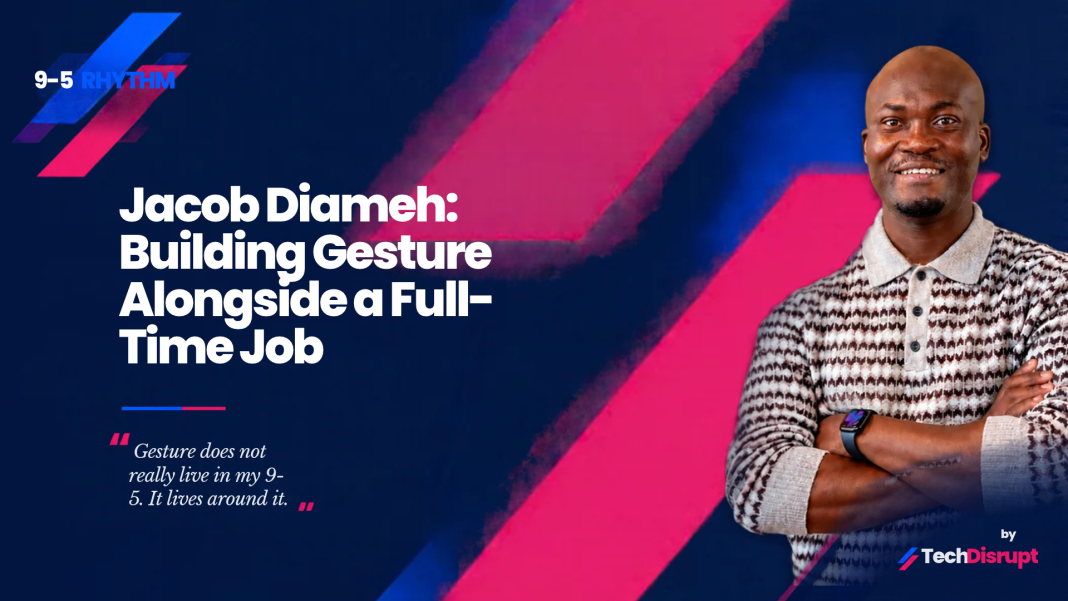

Jacob Diameh is a Ghanaian-born project manager based in Belfast, Northern Ireland, where he works at Queen’s University Belfast’s Advanced Manufacturing Innovation Centre. Outside his full-time role, he develops software through Promintal, including Gesture, an application that lets users control their computers with hand movements.
In this edition of 9–5 Rhythm, Diameh talks about fitting product development around his day job, building technology with accessibility in mind and the challenge of earning users’ trust as an independent developer.
TD: Please introduce yourself beyond your job title.
Jacob Diameh: I am someone who likes turning ideas into things that work, whether that is a large research programme or a small piece of software.
My career began in Ghana, where I studied systems engineering and information technology before working on enterprise digitalisation programmes with TATA Africa Holdings. In the UK, I have worked across industry and academia, including as a lecturer at the University of Lincoln. I also founded the Lincolnshire Black Community Network and Promintal Impact Africa Business, which supports African businesses through mentorship and training.
Today, I manage projects at Queen’s University Belfast. Outside work, I build software products and support people with career and business decisions.
TD: Walk us through a typical day building Gesture, from your first task in the morning to when you log off.
Diameh: Gesture does not really live in my 9–5. It lives around it. My working day belongs to my role at Queen’s, so I use the edges of the day to build the product.
Around 6 am, I check whether the overnight software builds have passed and look at feedback from users. Then it is on to the day job: programme meetings, partners, budgets and project risks.
Evenings are for building and testing. Hand tracking can behave differently depending on the lighting, camera angle and user, so I spend time testing gestures under different conditions. I usually log off between 11 pm and midnight. Bigger features, such as voice commands, get my weekends.
TD: What is Gesture, and how does it work?
Diameh: Point. Pinch. Your laptop follows.
Gesture lets you control a computer using hand movements captured by the laptop’s built-in camera. You can move the pointer, click, drag, scroll, switch desktops and control volume without additional hardware.
It uses hand-tracking technology to identify points on the hand and translate their movements into computer actions. The latest version also introduces voice commands and optional two-hand gestures.
Privacy is an important part of the design. Video is processed on the computer and discarded; it is not recorded or uploaded. The application does not require an account or an internet connection to work.
TD: What inspired you to build it?
Diameh: I have spent much of my working life lecturing, presenting to partners and funders, and running workshops. I kept encountering the same problem: whenever I needed to change a slide or open something on my laptop, I had to turn away from the people in front of me.
I also saw students and colleagues struggle with trackpads and mice. I began asking whether the camera already built into most laptops could be used to recognise hand movements and provide another way to control a computer.
Computer vision had become capable enough to make that possible. I wanted to build something people could install and rely on, not just a demonstration.
TD: Why is accessibility important to the product, particularly in an African context?
Diameh: For me, accessibility starts with a simple question: can people use a product with what they already have?
Many technologies assume users have a new device, reliable internet, a subscription and time to learn a complicated system. Those assumptions can exclude people. Gesture uses an existing laptop camera, works offline and does not require additional hardware.
In many African settings, data costs, unreliable connectivity and shared computers affect how people use technology. A tool that works offline and on existing devices is more practical in those conditions.
There is also the question of who technology is designed and tested for. Hand-tracking needs to work across different hands, skin tones and lighting conditions. As the product develops, I am also thinking about how voice control can better support African languages and accents.
TD: What has been the most difficult part of building Gesture?
Diameh: Testing has been one of the biggest challenges. People have different hands, cameras and environments, so improving accuracy takes hours of testing under different lighting conditions and at different distances.
Trust has also been difficult. When we first made the Windows installer available, some browsers and Windows Security flagged it because it was new and did not yet have a paid Microsoft code-signing certificate. For an independent developer, that creates an extra hurdle, particularly when the product uses a camera.
We have updated the download process, explained the warnings on the website and put code signing on the roadmap. I am also building Gesture alongside a full-time job and funding it myself so far. Time is probably my scarcest resource.
TD: What has been your proudest moment so far?
Diameh: The first time the pointer followed my finger smoothly across the screen. I remember moving my hand back and forth, watching the cursor follow, and laughing. It felt a little like magic, even though I knew how it worked.
Another milestone was introducing a live browser demo that allows people to try the gestures before installing the application. Seeing people experience it for the first time made the idea feel real.
More recently, I tested the voice command feature by standing away from my laptop and saying, “Gesture, next”, to move a presentation forward. That brought me back to the original problem I wanted to solve.
TD: What would you like Gesture to become over the next two years?
Diameh: I want Gesture to become a trusted, everyday way to use a computer, particularly in classrooms, lecture halls and meeting rooms, and for people who find a traditional mouse difficult to use.
That means improving installation and user trust, expanding voice control to more languages and accents, and allowing people to customise gestures. I also want to work with schools, universities and accessibility organisations in the UK and across Africa to test and improve the product with real users, including disabled people.
The bigger idea is that the way we interact with computers should not be fixed. Keyboards and mice are useful, but people deserve more than one way to use technology.
TD: What advice would you give someone in Africa with an idea for an accessible technology product?
Diameh: Start with a problem you have seen for yourself. Build the smallest version that works with the devices people already own and in the conditions they actually live in.
Put it in front of real people early. You will learn a lot by watching someone use your product and seeing where they struggle.
Use the tools available to you, and treat privacy and trust as part of the product from the beginning. Do not wait for funding to build your first proof of concept. Give people something they can try.
Explore Gesture: Website | Features | Try it live
This interview has been edited for brevity and clarity.
About 9–5 Rhythm
9–5 Rhythm is a TechDisrupt interview series about the everyday working lives of Black and African professionals across the UK — their careers, routines and experiences beyond the workplace.
Know someone whose working life deserves to be featured? Contact the TechDisrupt team to suggest an interview.