
The UK government has launched its Sovereign AI Visa Reimbursement Scheme, allowing qualified AI companies backed by the state’s Sovereign AI Fund to reclaim visa-related expenses for international talent recruited into R&D roles.
The scheme, which runs until March 2030, targets portfolio equity recipients and selected non-portfolio firms utilising state-backed compute or procurement contracts. Under the initiative, the government will absorb Certificate of Sponsorship fees, the Immigration Skills Charge, priority processing fees, and the costly Immigration Health Surcharge (IHS).
Portfolio companies may claim reimbursement for up to 10 qualifying R&D international hires. Non-portfolio grant and compute recipients can claim for up to 5 hires subject to Minimal Financial Assistance (MFA) subsidy control limits. Under these limits, total lifetime reimbursement per company is capped at £151,650, and the candidate must be successfully sponsored or endorsed under the Skilled Worker, Scale-up Worker, High Potential Individual (HPI), and Innovator Founder visa tracks.
Companies cannot claim the same hire under both this fund and the parallel Department for Business, Innovation, Science and Trade (BIST) Visa Reimbursement Scheme for Scale-Ups (VFRS4SU).
By footing the immigration bill for specialised engineers and researchers, the government is attempting to neutralise a major competitive disadvantage. High upfront visa overheads, which can easily top £10,000 to £14,000 per worker over a five-year visa, frequently push early-stage founders to look toward competing tech hubs in the US or Europe.
Tracing back to the AI Action Plan documented in January 2025, the policy signals a fundamental shift in how the UK approaches industrial strategy, treating immigration as a subsidised infrastructure cost. It follows the launch of the Sovereign AI Fund, part of a broader masterplan to ensure the UK develops home-based AI competencies. Under the framework, £500 million ($675 million) in state capital is committed to scaling homegrown artificial intelligence startups and reducing reliance on foreign technology, with check sizes ranging from £1 million to £10 million for early- and growth-stage companies.
While the UK has historically birthed foundational AI success stories like Google DeepMind, the state faces intense pressure to prevent the next generation of frontier AI startups from fleeing overseas. The Sovereign AI framework attempts to anchor these firms by pairing financial relief with technical muscle. It supports portfolio companies with access to the UK’s expanding supercomputer network—including the AI Research Resource (AIRR) and the Isambard-AI facility in Bristol—offering up to 1 million GPU hours for model training. The fund has already deployed capital into a highly watched cohort of frontier startups, including Callosum (its first investment), Isomorphic Labs, Ineffable Intelligence, and others.
- Callosum: Founded by Cambridge University neuroscientists, Callosum secured a $100 million seed round led by Atomico and the Sovereign AI Fund. The startup is tackling the global hardware bottleneck by building software that coordinates AI workloads across diverse, heterogeneous chip systems simultaneously.
- Ineffable Intelligence: Led by a former Google DeepMind reinforcement learning pioneer, Ineffable Intelligence closed an unprecedented $1.1 billion seed round, the largest of its kind in European history. Backed jointly by the fund and the British Business Bank, the company is building “superlearners” that continuously learn through direct experience rather than relying on human training data.
- CuspAI: Valued at $2.6 billion following a $450 million funding round backed by Jeff Bezos and the Sovereign AI Fund, the Cambridge-based firm acts as a search engine for rare materials, utilising advanced models to design novel materials for chipmakers and clean energy.
- Isomorphic Labs: Birthed out of London by Nobel laureate Sir Demis Hassabis, Isomorphic Labs uses next-generation frontier AI architectures to completely rewrite the timeline for clinical drug discovery and biological synthesis.
James Wise, the Chairman of the UK Sovereign AI Fund and Partner at Balderton Capital, has continually stressed that the UK must adapt its immigration and procurement rules to behave more like Silicon Valley investors rather than slow-moving bureaucrats. “The Sovereign AI Visa Reimbursement Scheme supports the wider objective of securing long-term strategic advantage for the UK by growing and anchoring strategically significant AI companies at key leverage points in the AI value chain.”
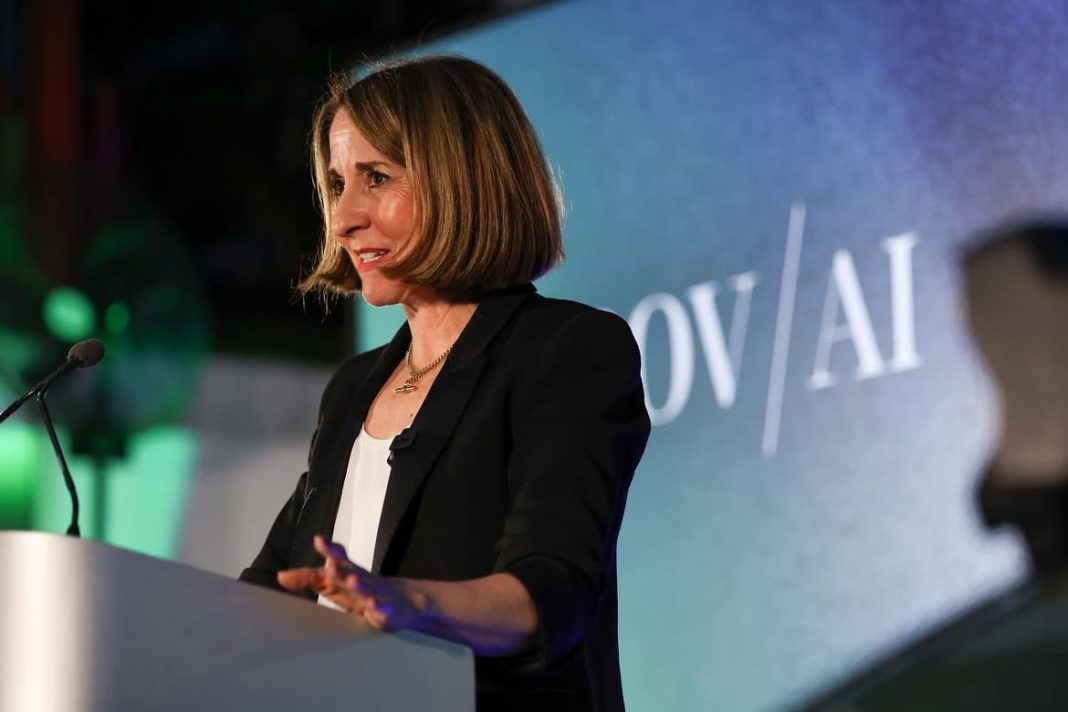
Meanwhile, Technology Secretary Liz Kendall framed the visa rollout as a matter of geopolitical and economic survival. “My mission is to make sure you never have to choose between your ambition and your home. And to anyone working in AI, wherever you live. In a world marked by such geopolitical uncertainty. If you want to shape an ambitious and responsible future for AI, come and build your company here.”
“Sovereign AI is unlike anything government has ever done before,” Kendall said during the formal unveiling of the initiative at the autonomous driving unicorn Wayve. “Its unique approach will help break down the barriers that have too often held back British enterprise and innovation. This is how we ensure Britain’s economic prosperity and national security in the modern age.”