
The UK’s artificial intelligence industry is competing for sovereignty, with new developments targeting a stay-and-scale agenda for startups in the country. From different national initiatives, including the £500 million for a new Sovereign AI Unit and its semiconductor technologies centre, the country is actively deploying funds targeting talent, capital, and infrastructure.
The UK’s latest government AI sector study found that the country had 5,862 AI companies in 2024, up sharply from 3,713 in 2023. The sector generated an estimated £23.9 billion in revenue, contributed £11.8 billion in gross value added, and supported more than 86,000 AI-related jobs. Investment in dedicated AI companies reached £2.9 billion in 2024, with the average investment deal rising to approximately £5.9 million.
In 2024, AI startups accounted for 27% of all UK venture capital investment, according to Dealroom. In 2025, the concentration spread across deeptech and AI companies together received £5 billion, around 63% of venture capital investment into UK companies.
In the first half of 2026, UK startups raised approximately $17 billion in venture capital, the strongest opening half-year since 2022. AI companies alone raised $12.6 billion, more than four times the amount raised in the first half of 2025 and almost three-quarters of all UK venture capital during the period. AI companies accounted for 19 of the UK’s 28 megadeals, while all four UK funding rounds above $1 billion went to AI-first businesses.
As investors increasingly place bets on AI, more money is being directed towards startups. This raises integral questions about where these funds are allocated and the share and size of capital going to different founders building the AI industry in the UK.
This matters, as ethnic-minority founders, including Black founders, have consistently received less than 2% of UK venture capital for over a decade. A 2025 report by Digital Catapult found that only 0.89% of UK investment went to Black founders between 2013 and 2023, with just 0.14% going to Black female founders.
This creates an interesting tension in Britain’s AI momentum. Black founders are already participating in the UK’s AI boom, building startups and products targeting solutions across industries, but whether they will be awarded equity is yet to be seen.
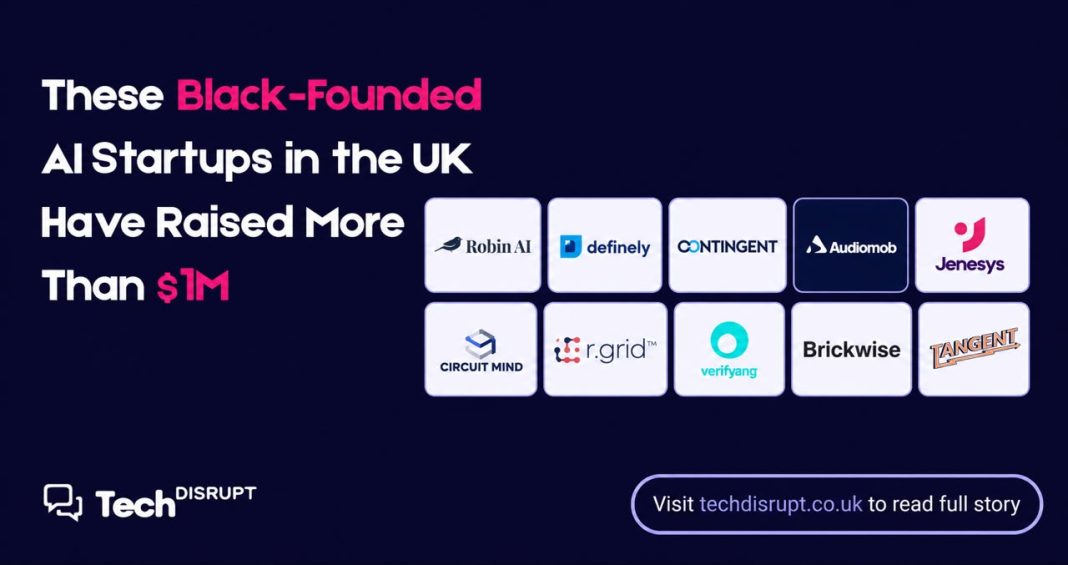
A TechDisrupt feature highlighted a few Black founders building AI startups in the UK. This time, the lens narrows to a more specific question: Which Black-founded AI businesses have managed to attract more than $1 million in capital?
The list is not a ranking, nor does the funding point to the best Black AI startups in the UK. It spans different types of AI companies across industries. Some startups are building generative-AI products while others use machine learning, computer vision, automation or AI-enabled infrastructure.
Their funding journeys also vary considerably across different stages.
Robin AI — $68M
Founded: 2019
Founders: Richard Robinson and James Clough
Headquarters: London, with operations in the US and internationally
Sector: Legal technology / Generative AI
Latest funding round: 2024
Investors: Temasek, QuantumLight, Plural, AFG Partners, and others.
Robin AI was founded in 2019 by Richard Robinson, a former lawyer at Clifford Chance, and James Clough, a machine-learning research scientist who studied at King’s College London and Imperial College London. The pair combined legal expertise with machine-learning research to build AI tools for one of the most document-heavy areas of professional services: corporate law.
Robin AI’s technology helps businesses draft, review, negotiate, and search contracts. Its legal copilot works within Microsoft Word, while its platform can also analyse large contract repositories. The company’s approach combines large language models with its own contract data and a human-in-the-loop team of legal professionals. Robin AI says its models have been trained using data from more than 2 million contracts.
The company raised $26 million in Series B funding in January 2024, led by Singapore’s Temasek, with QuantumLight, Plural and AFG Partners also participating. Earlier rounds brought its total funding to approximately $68 million, according to company and funding databases.
Robin AI has said its technology has processed more than 500,000 contracts, while its customer base includes major companies such as GE, Pfizer, KPMG, PwC, Yum Foods, Blue Origin, and the University of Cambridge. The company has also reported that it serves more than 100 major corporate customers and that around 75% of its revenue comes from the US.
Definely — $40M
Founded: 2020
Founders: Nnamdi Emelifeonwu and Feargus MacDaeid
Headquarters: London
Sector: Legal technology / AI
Latest funding round: 2025
Investors: Revaia, Octopus Ventures, Alumni Ventures, Beacon Capital, Clio, Zrosk Investment Management, The Raine Group, Cornerstone VC, and others.
Definely sits at the intersection of legal expertise and artificial intelligence. The startup was founded by Nnamdi Emelifeonwu, who was born in Nigeria and moved to the UK, and Feargus MacDaeid. Both founders previously worked at Freshfields, one of the UK’s Magic Circle law firms.
The solution was personal. MacDaeid is registered blind and had struggled to navigate complex legal documents. What began as an attempt to make legal information more accessible evolved into a much broader legal technology platform.
Definely uses AI to help lawyers create, draft, and review contracts, while surfacing information across complex documents without forcing lawyers to leave Microsoft Word. Its newer AI products are designed to automate more sophisticated legal workflows.
The company raised $30 million in Series B funding in June 2025, bringing total funding to $40 million. The Series B included Revaia, Alumni Ventures, Beacon Capital, and Clio, alongside earlier investors including Octopus Ventures, Zrosk Investment Management, The Raine Group, and Cornerstone VC.
According to Emelifeonwu, Definely nearly tripled annual recurring revenue in 2024, had more than 100 legal-team customers, and expanded its team to more than 100 people. Its customer base includes A&O Shearman, Slaughter and May, DLA Piper, Dentons, BT Group, Deloitte, and P&O Cruises.
The US has also become increasingly important, accounting for approximately 30% of revenue in 2025.
AudioMob — $25M
Founded: 2020
Founders: Christian Facey and Wilfrid Obeng
Headquarters: London
Sector: Advertising technology / Gaming
Latest funding round: 2025
Investors: Makers Fund, Lightspeed Venture Partners, Google, Sequoia Scout Program, and others.
AudioMob was founded in 2020 by Christian Facey, a former Google and Facebook executive, and Wilfrid Obeng, a former Google engineer. They both met in Dublin in 2017 and began exploring ways to bring audio advertising into mobile games without interrupting gameplay.
They built an advertising format that allows players to hear advertisements while continuing to play rather than being interrupted by conventional video or display ads.
AudioMob raised $14 million in Series A funding in 2021. The round was led by Makers Fund and Lightspeed Venture Partners, with participation from the Sequoia Scout Program and Google. It also secured an additional $5M extension round in 2025 backed by Samsung and Founders Capital.
The company now reports 300 million monthly active users, more than 15 billion monthly bid requests, integration across 1,200 apps and operations spanning 160 countries. Its customers have included major brands and artists such as Warner Music, BMG, Nestlé, Intel, Jeep, Ed Sheeran, and Nas.
Contingent — $11M
Founded: 2020
Founders: Tai Alegbe and Raj Wilkhu
Headquarters: London
Sector: Supply-chain intelligence / Enterprise software
Latest funding round: 2022
Investors: Octopus Ventures, Connect Ventures, Concentric, Seedcamp, Ascension, and Working Capital Innovation Fund.
Contingent was founded by Tai Alegbe and Raj Wilkhu to address the difficulty of understanding whether suppliers are trustworthy, compliant, and capable of delivering what they promise.
Its software helps companies assess suppliers, manage procurement, and identify third-party risks across areas including financial resilience, compliance, sustainability, and ESG.
The company raised $8.2 million in a 2022 round led by Octopus Ventures, bringing total funding to approximately $11 million. Other investors include Connect Ventures, Concentric, Seedcamp, Ascension, and Working Capital Innovation Fund.
At the time of the Series A, Contingent said its global customer base was growing by more than 10 times, with organisations including Monzo, Seagate, Huel, Barratt Developments, and the UK government using the platform.
Research Grid — $8M+
Founded: 2020
Founder: Dr Amber Hill
Headquarters: London
Sector: Healthtech / AI automation
Latest funding round: 2024
Investors: Fuel Ventures, Arve Capital, Ada Ventures, Morgan Stanley Inclusive Ventures Lab, Arāya Ventures, Ascension, Plug and Play, and Atomico Angels.
Dr Amber Hill founded Research Grid after spending approximately 14 years working in medical research and experiencing first-hand how much researchers’ time was consumed by administrative work.
The company’s central proposition is that clinical trials are expensive and slow partly because too much of their administration remains manual.
Research Grid’s AI-powered automation platform covers clinical-trial workflows from patient recruitment and engagement through to trial management, data, and reporting. Its two main products are Inclusive and TrialEngine.
A study at Queen Mary University of London (QMUL) demonstrated that Research Grid’s AI automation engine successfully automated a major cardiac imaging trial involving three years of historical data from over 600 patients.
The company raised a $6.5 million seed round in November 2024, led by Fuel Ventures. Investors included Arve Capital, Ada Ventures, Morgan Stanley Inclusive Ventures Lab, Arāya Ventures, Ascension Ventures, Plug and Play Ventures, and Atomico Angels. Research Grid’s total venture funding is reported at approximately $8 million.
The company says customers have achieved 98% efficiency gains and 45% cost savings, while its patient-engagement network covers more than 96,000 verified communities across 157 countries.
VerifyMy — $6.2M
Founded: 2019
Founder: Ryan Shaw
Headquarters: London
Sector: Safety technology / AI
Latest funding round: 2023
Investors: Marijn Muyser and other angel investors.
VerifyMy is a safety-technology company working on how platforms can verify age, identity, and consent while managing illegal or harmful content.
Founded by Ryan Shaw in 2019, VerifyMy combines identity verification, AI, and human content moderation to help online platforms meet increasingly stringent safety requirements.
The company raised £5 million (approximately $6.2 million) in 2023, with Booking.com founder Marijn Muyser among the investors.
VerifyMy’s technology has been used by major brands, including eBay and Toolstation.
Brickwise — $3M+
Founded: 2025
Founders: Ismail Jeilani and Elias Kassell
Headquarters: London
Sector: Proptech / Agentic AI
Latest funding round: 2025
Investors: Y Combinator and other investors.
Founded in 2025, Brickwise is an AI property manager that handles maintenance requests and tenant calls and messages, follows up with contractors, and helps resolve property-management issues around the clock.
Its co-founder and CEO, Ismail Jeilani, is a serial entrepreneur. Before Brickwise, he founded LiveLink AI, an AI video-editing platform that processed approximately 150,000 videos per month for more than 1,000 customers and raised $3 million. He also previously built a proprietary trading business for $500,000 in annual recurring revenue.
Brickwise has raised more than $3 million, backed by Y Combinator.
Tangent — $1.1M+
Founded: 2022
Founder: Gary Izunwa
Headquarters: London
Sector: HR tech / AI
Latest funding round: 2024
Investors: ZINC, Google for Startups, SyndicateRoom, Atomico, Ada Ventures scouts, and angels.
Tangent is an AI-powered marketplace for professional connections. The startup was founded by ex-LinkedIn employee Gary Izunwa to make professional referral networks more accessible to job seekers from low socioeconomic and less-advantaged backgrounds.
The platform allows job seekers to submit video pitches that employees can review and uses AI and video tech to curate this marketplace for employers and employees to explore.
Tangent has worked with major global tech brands and unicorns, including Amazon, Stripe, Revolut, GoCardless, and Multiverse.
The company raised $1.1 million in pre-seed funding, backed by ZINC, Google, SyndicateRoom, Atomico, and Ada Ventures scouts alongside a large group of angel investors.
Circuit Mind — $7.11M
Founded: 2018
Founder: Tomide Adesanmi
Headquarters: London
Sector: Deeptech / AI
Latest funding round: 2022
Investors: Episode 1, JOIN Capital, Entrepreneur First, and Google for Startups’ Black Founders Fund.
Founded by Tomide Adesanmi, a Nigerian-born engineer, Circuit Mind is building AI-powered tools to automate parts of electronic engineering and hardware design.
The startup addresses the time constraints engineers face when building products such as autonomous vehicles and robotics. Its technology works across tasks, including component selection, schematic generation, power-tree design, and verification.
The startup has also partnered with Cadence, one of the major software companies in electronic-design automation, to combine technologies that can generate designs and validate them using established simulation tools.
Circuit Mind has received backing from investors, including Episode 1, JOIN Capital, Entrepreneur First, and Google for Startups’ Black Founders Fund.
Jenesys AI — $1.1M
Founded: 2023
Founders: Oluwatosin Dairo and Nicolai Thomson
Operations: London and Lagos
Sector: Fintech / AI
Latest funding round: 2023
Investors: Twin Path Ventures, Antler, Fuel Ventures, Hatcher+, and angels.
Jenesys AI was founded by Nigerian entrepreneur Dr Oluwatosin Dairo and Nicolai Thomson to automate accounting, invoice management, and financial compliance.
Its AI copilot, Jack, is designed to take over repetitive financial workflows, including invoice management, budgeting, bookkeeping, and compliance checks.
The company raised $1.1 million in pre-seed funding in December 2023, led by Twin Path Ventures with participation from Antler, Fuel Ventures, Hatcher+, and 11 angels from the US and UK.
Jenesys operates from London while maintaining a significant presence in Lagos, with its Nigerian operation forming part of its engineering capacity.
The company has also acquired VAT Key, a Danish digital tax technology company, for a six-figure sum, adding tax and compliance expertise to its product.