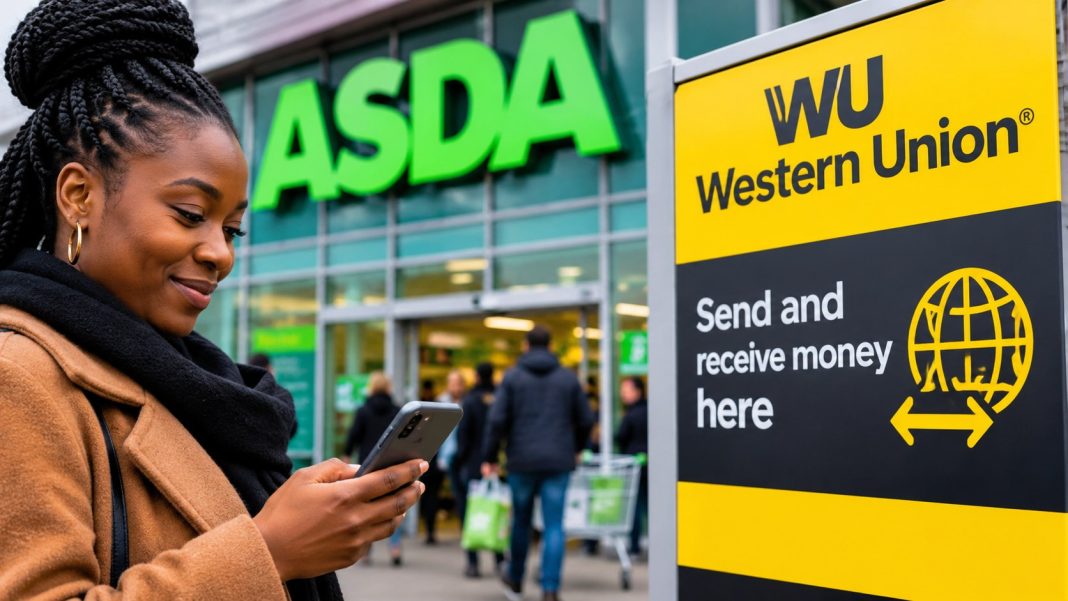

Western Union and Travelex are launching international money transfers at 124 Asda Travel Money bureaux in the UK, bringing cash- and card-funded remittances into supermarket locations.
The partnership also covers 39 Travelex shops in the Netherlands. In Britain, customers can visit participating Asda Travel Money bureaux operated by Travelex and fund a Western Union transfer with cash or a card. Recipients can receive money in eligible bank accounts or pre-registered mobile wallets, or collect cash from Western Union agents, depending on the destination.
The rollout adds a physical route into Western Union’s network, which reaches more than 200 countries and territories. It does not mean every Asda store offers transfers: Asda advertises more than 200 travel-money bureaux nationally, but only 124 are included in this initial launch.
Why supermarket remittances matter
For people in Britain sending money to relatives overseas, the ability to pay in cash and speak to staff in person can be useful, particularly when the recipient relies on cash collection rather than a bank account. This includes some migrant and diaspora households, although the companies have not published a breakdown of customers by nationality or destination.
At the same time, digital remittance providers compete for these customers through apps, direct bank deposits and mobile-wallet transfers. Western Union’s new retail distribution gives it another way to reach senders who do not want an entirely online transaction. Travelex, meanwhile, can offer money transfers alongside its existing currency-exchange services without establishing separate shops.
The arrangement runs on Western Union’s point-of-sale software. The companies say transfers can arrive within minutes on some routes, and next-day delivery is available in selected markets. Those are conditional service options, not a guarantee that every transfer will arrive immediately.
Will it be cheaper to send money?
The announcement does not disclose a standard fee schedule or exchange-rate comparison for the Asda service. It is therefore not possible to conclude that transfers through these bureaux will cost less than using Western Union online or digital competitors such as Remitly, LemFi and Taptap Send.
Customers should compare the total amount the recipient will receive, including the transfer fee, currency conversion rate and any applicable payout charges. Western Union states that fees, rates and delivery times depend on the destination, payment method and service chosen.
The companies also have not specified in their announcement which African destinations support each payout method through the new retail arrangement. That detail matters for customers sending money to countries including Nigeria, Ghana and Kenya, where bank transfers, mobile wallets and cash collection may have different availability.
UK remittance market
Travelex cited World Bank figures indicating that UK consumers sent close to £10 billion abroad in 2025, with Romania, India, Jamaica, Pakistan and the Philippines among prominent destinations. This figure relates to the wider outbound market, not the new Asda partnership.
For Western Union, the expansion reflects the continued role of cash-funded and face-to-face transfers alongside digital payments. The commercial test will be whether the additional locations offer convenient opening hours, competitive total costs and the payout options customers need.
The companies describe the 124 UK bureaux as the first phase of the rollout. They have not announced a timetable for further UK locations.