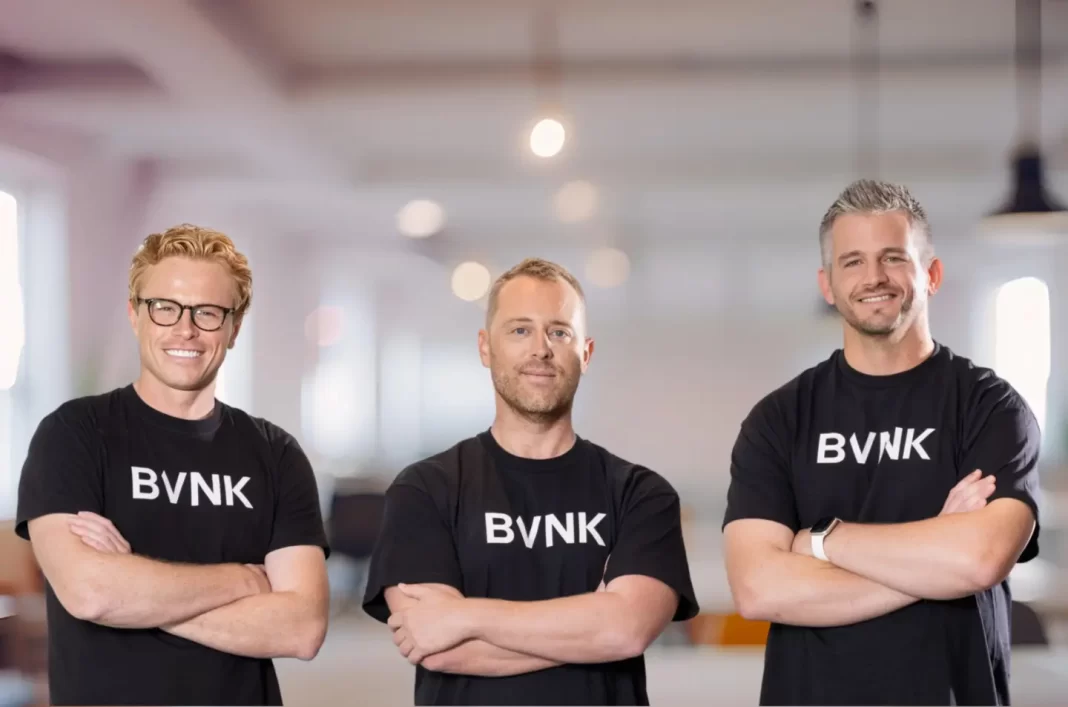

When Jesse Hemson-Struthers, Chris Harmse and Donald Jackson founded BVNK in London in 2021, stablecoins were still largely a trader’s tool, a way to move in and out of crypto positions without touching a bank.
Five years later, BVNK’s infrastructure sits inside some of the world’s largest payment networks.
Mastercard agreed to acquire the company for up to $1.8 billion, including $300 million in contingent consideration, and later confirmed the deal had closed in August 2026.
From a South African frustration to a London company
All three founders are South African: Hemson-Struthers had previously built e-commerce and gaming ventures acquired by Naspers and Sportradar, respectively. Chris Harmse is a Chartered Financial Analyst and former FX trader who held roles at BNP Paribas, Centaur Asset Management and Asymmetry Asset Management before building a crypto and FX OTC desk at Coindirect. Donald Jackson, the CTO, had founded Cue, a customer engagement platform, and Verity, a fraud-reduction service, and brought enterprise systems and blockchain experience.
They had lived the problem they were trying to solve: sending money across borders from South Africa meant high fees, multi-day delays, and opaque correspondent banking chains. As Harmse later put it, stablecoins offer “the stability of dollars but can move faster across borders on blockchain systems” — and in countries like South Africa or Nigeria, people use them to hold digital dollars because “it’s hard to buy dollars locally” and to hedge against currency depreciation.
BVNK grew from four people to 20, then 100, then close to 300 staff, with offices in London, San Francisco and Cape Town.
What BVNK sells
BVNK is a B2B stablecoin payments infrastructure provider. In practice, that means managed and self-managed payment solutions enabling businesses to send, receive, convert and store stablecoins.
Its customers are not retail crypto users. They are fintechs, marketplaces, trading platforms, gaming companies and global payroll providers — businesses that need to pay people or suppliers across borders, at scale, outside banking hours.
The product surface grew to cover payouts, acceptance, wallets, conversion, cards and treasury operations, paired with UK, EU and US licensing. By 2025, the company reached $30 billion in annualised stablecoin payment volume, and its momentum carried straight into 2026, with named enterprise users including Worldpay, Deel and Corpay.
BVNK positioned itself as an infrastructure layer that handles compliance, wallet restrictions and settlement logic, leaving out the operational complexity for clients. It built compliance as infrastructure, using automated onboarding, real-time sanctions screening and transaction monitoring on both crypto and fiat sides, and working with firms such as Chainalysis and Elliptic.
The funding path
BVNK’s capital path shows a company moving from a venture bet to a strategic asset in about five years.
Its Series B was a $50 million equity round led by Haun Ventures with participation from Coinbase Ventures, Scribble Ventures, DRW Venture Capital, Avenir and Tiger Global in December 2024. That round valued the company at around $750 million, according to contemporaneous reporting.
What changed the story in 2025 was not more venture money but a strategic injection. The first was Visa’s investment through Visa Ventures in May 2025, followed by Citi Ventures’ in October of the same year, pushing BVNK’s valuation above $750 million.
By then, BVNK was processing $12 billion in annualised stablecoin payment volumes, according to its own announcement at the time of the Visa investment, and it expanded into the US with offices in San Francisco and New York.
“When global players invest in your business, it becomes very real,” said Harmse in a recent publication.
The bidding war — and why Mastercard won
By late 2025, BVNK was at the centre of a bidding war. Coinbase and Mastercard were both reported to be in advanced talks, with valuations discussed between $1.5 billion and $2.5 billion.
Coinbase at one point reportedly offered up to $2.5 billion, but ultimately withdrew. According to later reporting on the process, the founders not only focused on price but also placed more importance on long-term partnership and cultural alignment. One early investor was quoted as saying, “Although Coinbase may have offered a higher price, the chemistry between the two parties was not ideal.”
Mastercard, which had been involved early, re-emerged as the primary buyer and completed the acquisition for up to $1.8 billion. Visa, which had invested and held a board observer seat, ultimately chose not to pursue a direct acquisition, opting instead for an open strategy of collaborating with multiple stablecoin companies.
Until Mastercard announced its definitive acquisition agreement in March 2026, BVNK’s last publicly disclosed valuation was $750 million from its Series B round. The Mastercard deal was the first definitive public proof BVNK had crossed the unicorn threshold.
BVNK explicitly stated that it would retain operational independence post-close so its team could keep executing on its product roadmap with speed and focus. “Even post-close, we will continue to operate with the independence we need to execute on our roadmap with focus and speed.”
Why the incumbents needed BVNK
For Visa and Mastercard, BVNK solved a strategic problem: stablecoins threatened to bypass card networks entirely by letting consumers pay merchants directly from crypto wallets.
In January 2026, BVNK announced it would power Visa Direct, Visa’s $1.7 trillion real-time payments network with stablecoin payments. Visa had chosen BVNK to support pilots that allow some business customers to pre-fund cross-border payouts in stablecoins and deliver digital US dollars directly to recipients’ wallets.
For Mastercard, the logic was similar but deeper: own the rail, don’t just rent it.
That logic became visible when Open USD (OUSD) went live on September 30, 2026, backed by Open Standard, a consortium of major payments and financial players including Mastercard, Visa, Stripe, Coinbase, Shopify, and BlackRock. Issued by Stripe’s Bridge subsidiary across Ethereum, Solana, Base, and Tempo, OUSD offers zero-fee 1:1 minting and redemption while sharing reserve yield back with the partner platforms that distribute it. From day one, businesses could mint and redeem it through the platform.
Rather than relying on a third-party infrastructure vendor to plug into OUSD, Mastercard immediately positioned BVNK as its primary institutional gateway. By November 2026, BVNK had rolled out full self-serve minting, redemption, custody, and 1:1 USD conversion for OUSD across its platform for eligible business clients outside the European Economic Area (EEA).
By August 2026, Visa was already seeking new stablecoin settlement partners to replace BVNK following the Mastercard acquisition, a sign of how quickly an infrastructure partner can become a competitor’s asset.
What it means beyond London
The use case that drove early adoption for BVNK was not in London or New York but in the Global South. BVNK’s own Stablecoin Utility Report, surveying over 4,600 early adopters in 15 countries, found 39% of people say they now receive income in stablecoins, including salaries, freelance pay and cross-border work.
“Adoption of stablecoins is high in the global south, including South Africa and Nigeria,” Harmse noted.
The infrastructure that lets a Deel contractor get paid in stablecoins or a Worldpay merchant settle cross-border payouts without waiting days is the same now owned by Mastercard. Whether that makes stablecoin payments cheaper and more accessible or simply consolidates them inside the existing card duopoly is the open question.
The risks that remain
BVNK’s rise coincided with regulatory clarity, notably the US GENIUS Act of July 2025, which provided a framework for stablecoin oversight and accelerated institutional confidence.
BVNK secured a Crypto-Asset Service Provider licence from the Malta Financial Services Authority in early 2026, enabling digital asset services across all European Economic Area member states. It still has to navigate UK, EU, US and emerging-market regimes that are moving at different speeds.
There are also commercial risks. Public economics, revenue, margin, and customer concentration remained materially incomplete in public sources even at acquisition. And $30 billion in annualised volume is not the same as $30 billion in revenue; infrastructure businesses earn a thin slice of the flow they process.
Finally, there is the independence question. If BVNK becomes too closely tied to Mastercard, will Visa, Stripe and other networks still treat it as neutral infrastructure or build around it?